



External-Rotor Motors
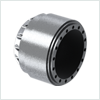 | Rotor: Rotating part of the motor. |
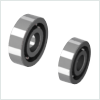 | Bearings: Basically, bearings are bearings with two rings one inside the other and small balls between these two rings in order to provide rotation. Thanks to special initial lubrication, bearings do not require maintenance and operate in desired installation position, in a temperature range of -40° and +150°C. Their estimated service life varies between 20.000 and 30.000 hours based on operating conditions. |
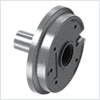 | Bottom cover: The part on which the bearings rest in order to act as housing for the rotor shaft. |
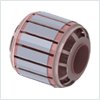 | Stator: Static part of the motor. |
Shaded-Pole Motors
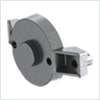 | Top cover: The part on wihch the bearings rest in order to act as housing for the rotor shaft. |
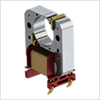 | Stator: Static part of the mtor. |
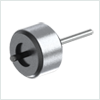 | Rotor: Rotating part of the motor. |
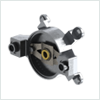 | Bottom cover: The part on wihch the bearings rest in order to act as housing for the rotor shaft. |
Motor Insulation Classes
Maximum operating temperature and maximum temperature rise values for motors were standardized by NEMA (National Electrical Manufacturers Association) and several insulation classes were defined accordingly. Ambient temperature is accepted to be 40°C in this classification.| Insulation Class | Max. Allowed Operating Temperature | |
|---|---|---|
| A | 105°C | 221°F |
| E | 120°C | 248°F |
| B | 130°C | 266°F |
| F | 155°C | 311°F |
| H | 180°C | 356°F |
Motor Speed and Number of Poles
Number of poles in a motor is related to the design of winding in the stator and it is an important factor affecting the speed and torque of the motor. Higher number of poles decreases the motor speed while increasing the amount of torque offered. The relation between number of poles and motor speed is shown in the table below.| Number of Poles | Motor Speed (Rpm) |
|---|---|
| 2 | 2800 |
| 4 | 1400 |
| 6 | 900 |
| 8 | 700 |
| 12 | 450 |
| 16 | 350 |


